


Scroll your LinkedIn feed and you’ll come away convinced every finance team has built an army of seamless, autonomous AI workflows powering their business. Every other post features a company or finance leader describing finance and accounting workflow that runs itself while they sip coffee. If you’re not there yet, it’s easy to feel like you’re falling behind.
I recently had the chance to test that narrative against reality in an industry that not only faces accounting complexity, but clinical complexity as well. At a recent gathering of biopharma finance leaders in San Francisco, we ran an informal AI "vibe check", conducting a live poll on how their teams view AI, and how they’re actually using it today.
The primary takeaway: while enthusiasm and commitment run high at both the company and individual level, actual adoption of AI is still nascent.
We asked attendees to plot themselves on two axes: how broadly their company has adopted AI, and how much AI has transformed their own day-to-day work. The matrix that we reviewed was as follows:
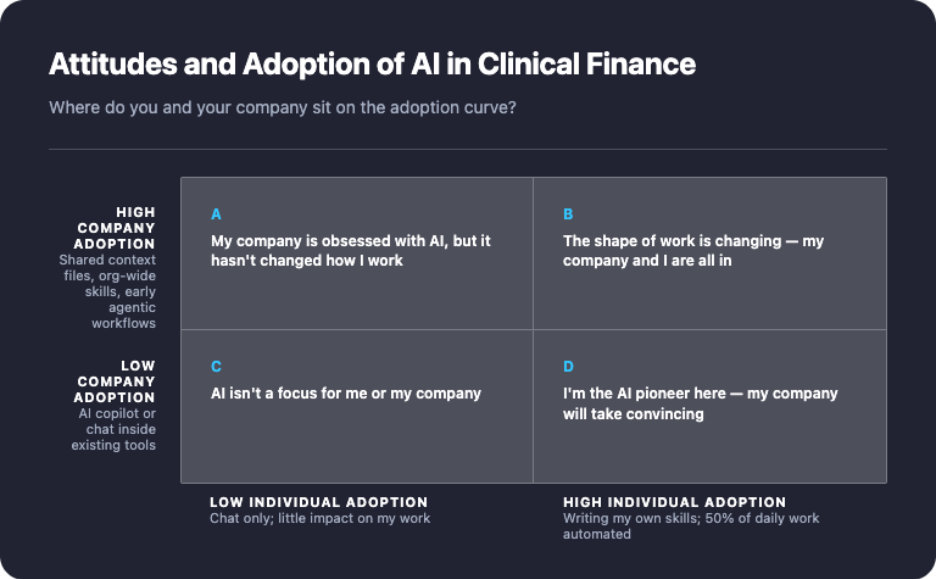
The breakdown was telling:
On the surface, that 60% figure suggests widespread transformation. But when we asked a follow-up question: How much is your company actually spending on AI per employee per month - the picture shifted dramatically.
When estimating their AI token costs, the overwhelming majority landed at roughly the cost of a single seat to a general-purpose LLM per person. This spend level is inconsistent with widespread AI transformation, and indicates that the vibes are significantly ahead of the actual implementation.
This gap between sentiment and spend mirrors broader market dynamics. Ramp’s AI Index, which tracks AI spend per employee per month across its customer base, reveals a stark dispersion:
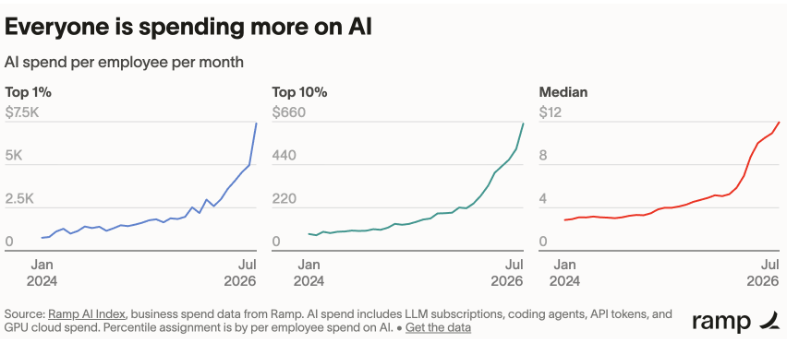
This raises two critical questions for finance teams: Where does your organization fall on that spectrum, and have you started doing the FTE-versus-AI math?
Based on our room in San Francisco, most biotech finance teams haven't run those numbers yet. That isn't a failure; it simply means the online hype doesn't reflect what your peers are doing in practice.
The underlying theme from the room wasn't skepticism about AI’s potential; it was an indication of the significant operational investment required to make it useful.
Madie Hollingsworth, CPA on our technical accounting team, framed it clearly:
One attendee highlighted the friction of skipping that onboarding step, especially with general-purpose LLMs. For one-off tasks, she noted that she often spends more time feeding context into a general LLM (i.e. ChatGPT or Claude) than it would take to perform the task manually.
That is the hidden tax of general-purpose AI: before software can save you time, someone has to train it on the ins and outs of your domain, and build some semblance of guardrails to guide the output.
The tension between the effort required to context-train a general LLM and the appeal of domain-aware software is why we built Auxilius.
Clinical trial finance is uniquely problematic for casual AI deployment. A single procedure can be represented three different ways across three disparate systems: an "abdomen MRI with contrast" in the site contract, an "MRI of liver" in the EDC, and "patient imaging / MRI fees" in a vendor invoice. Point a generic LMM at those sources without shared taxonomy and entity resolution, and you get unreliable outputs that can change every time you rerun the prompt.
Our proposed solution is framed in a recent article written by Our Head of Product, Kristen Lueck: AI belongs at the edges of your workflow, not in the middle.
This approach delivers tangible outcomes. In practice, one of our customers surfaced over $1.2M in vendor double-billing, and across all customers we’ve found a 3 to 20-month lag between work performed at sites and invoices received by sponsors. These insights require a structured clinical finance data backbone, not a chat window and prompt engineering.
The advantage of purpose-built infrastructure is that finance teams don't have to carry the model-training burden themselves. We've already built the underlying ontologies, site-level taxonomies, and entity resolution into the platform so you get immediate leverage without risking financial integrity.
We’ll be sharing more insights and practical frameworks on how to deploy AI responsibly within clinical financial workflows. Keep an eye on our blog and LinkedIn for upcoming pieces on how we're continuing to build purpose-built automation for biotech finance teams.
To everyone who joined us in San Francisco: thank you for the candor. No hype, no judgment - just real data from the field and excitement about what’s next.
.svg)
.jpg)