Why purpose-built clinical trial financial management deserves a much bigger place in the technology conversation.
Life sciences operates under extraordinary scrutiny. We document decisions, validate systems, protect data, manage risk, maintain audit trails, and build layers of controls so that what happens in a clinical trial can be understood, defended, and reproduced.
And then we build a $300 million study forecast in Excel.
Think about that for a minute.
For an industry built around innovation, some of the tools used to manage the financial side of clinical development have not kept pace with the complexity of the work.
I’ve spent nearly two decades working in and around clinical trial finance. I thought I had a pretty good understanding of the technology available to us. I was wrong. And apparently, I wasn’t alone.
When I told industry friends I was joining Auxilius, I generally got one of two reactions: “Oh wow—that’s a great fit for you!” or “Auxilius? What do they do?” The interesting part was what happened after I explained it. The second group almost invariably became the first.
But even after joining the company, I didn’t fully appreciate what had been built—or how fundamentally different clinical trial financial management can look when the technology is designed around the financial lifecycle of a study rather than around individual transactions.
So rather than start with a product pitch, I want to start with the problem.
Because the more interesting question isn’t “What does Auxilius do?”
It’s this:
Why are we still managing some of the most consequential financial decisions in clinical development with tools that were never designed for clinical trials?
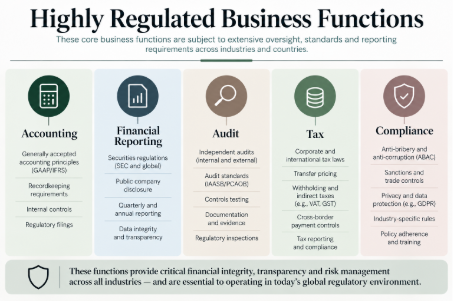
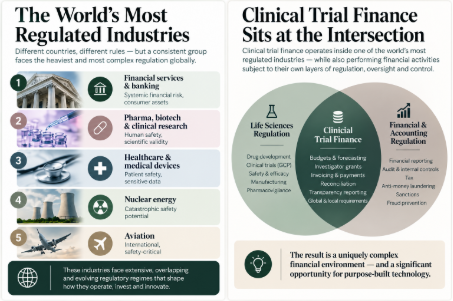
Life sciences is among the world’s most heavily regulated industries. Clinical trial finance adds another layer of complexity because the work also touches highly controlled business functions: accounting, financial reporting, audit, tax and compliance.
That intersection matters. Finance and accounting teams working in clinical development must manage scientific and operational uncertainty while also meeting expectations for financial integrity, transparency, documentation and control.
We would not expect a global bank to manage a critical financial process through disconnected spreadsheets, institutional knowledge and manual reconciliation. Yet in clinical development, that operating model has become surprisingly normalized.
The scale is enormous. The visibility is not.
More than a decade ago, pharmaceutical companies were already estimated to spend over $12 billion annually in clinical-trial grants to investigator sites. Since then, site costs have risen dramatically; recent oncology research found per-patient investigator grant costs increased 133%–175% between 2015 and 2025.
And yet there still isn’t a widely accepted public figure for how much the industry spends globally on investigator grants.
THINK ABOUT THAT
We can estimate the size of the global clinical trials market. We can debate what it costs to develop a drug. But one of the largest and most variable cost categories inside a trial remains remarkably difficult to quantify at an industry level.
This is where clinical trial financial management technology enters the conversation. Not another spreadsheet. Not another reporting layer. And not simply a system for processing transactions.
At its best, purpose-built clinical trial financial management technology connects the financial lifecycle of a study and helps answer four deceptively simple questions:
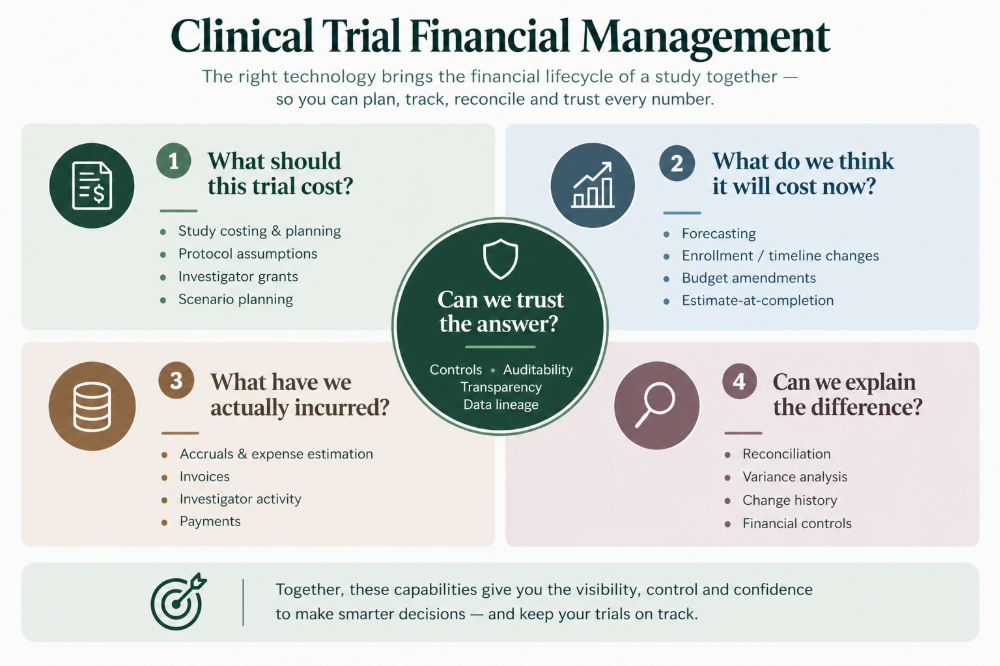
And underneath all four sits the most important question:
Can we trust the answer?
A connected financial lifecycle: plan, forecast, understand what has been incurred, reconcile—and trust the result.
This is the part I didn’t fully appreciate before I joined Auxilius.
I have a reputation for being a “site payments expert,” but over the past few years my focus has expanded to clinical trial financial management as a whole—not just payments, and not just fair market value, but the entirety of clinical spend.
This industry does extraordinary things. It also loses time and money to budget overruns, weak planning assumptions, forecast uncertainty and fragmented data. We have enormous amounts of data; the challenge is turning it into financial intelligence that teams can actually use.
What has impressed me about Auxilius is the ability to bring multiple data sources together in one financial view: supporting defensible accruals, strengthening forecasts as studies inevitably change, reconciling investigator activity and payments, and giving study teams and Finance a clearer view of what is happening and why.
Just as important, it does not require the rest of the clinical technology ecosystem to disappear. A modern financial platform has to work with the systems and data sources already surrounding the trial.
That is the part of this next chapter that excites me most: not simply doing an existing process faster, but changing what clinical trial finance teams can know, explain and act on.
If we wouldn’t tolerate our bank managing
our money with a 15-tab spreadsheet,
why have we normalized that practice in clinical trials?
Maybe the problem isn’t that the right tools don’t exist. Maybe it’s that too many people don’t know they exist.